GHK-Cu Copper Peptide: The Science Behind Skin’s Most Talked-About Molecule

GHK-Cu Copper Peptide: The Science Behind Skin’s Most Talked-About Molecule
If you’ve spent any time in skincare or longevity circles recently, you’ve undoubtedly encountered the buzz surrounding GHK-Cu copper peptide. However, separating genuine science from marketing hype requires understanding what this tripeptide actually does at a cellular level. Therefore, this post breaks it down clearly.
What Is GHK-Cu?
To begin with, GHK-Cu (glycyl-L-histidyl-L-lysine copper) is a naturally occurring copper complex tripeptide found in human plasma, saliva, and urine. Specifically, it was first isolated in 1973 by Dr. Loren Pickart. Since then, it has become one of the most extensively studied peptides in dermatology and regenerative medicine.
Here’s the key detail GHK on its own is simply a peptide. Rather, it’s the copper ion (Cu²⁺) bound to it that does the heavy lifting. In essence, the GHK molecule acts as a delivery vehicle, transporting copper into cells where it subsequently triggers a cascade of biological responses.
Furthermore, your body produces GHK-Cu naturally. Nevertheless, these levels decline steadily with age. For instance, by age 60, your natural GHK-Cu levels drop to roughly half of what they were at age 20. Consequently, that decline tracks closely with visible signs of aging — thinner skin, slower wound healing, and reduced collagen production.
How GHK-Cu Copper Peptide Works
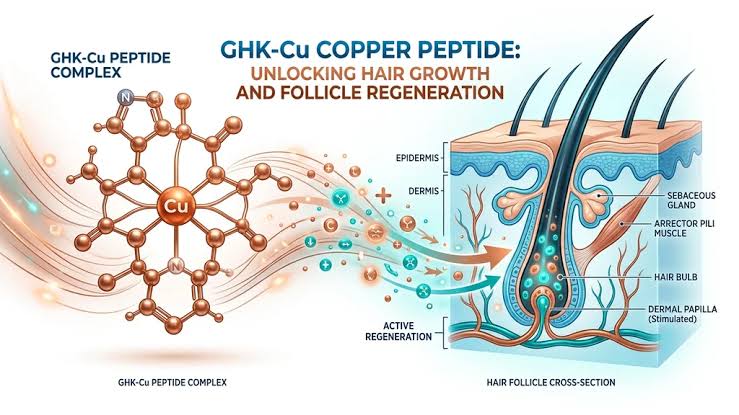
Understanding how GHK-Cu works requires looking at several documented mechanisms. First and foremost, it stimulates collagen and elastin production by upregulating genes responsible for extracellular matrix proteins. Additionally, it promotes angiogenesis, meaning it encourages new blood vessel formation, thereby improving nutrient delivery to tissue.
Moreover, GHK-Cu modulates inflammation by suppressing pro-inflammatory cytokines while simultaneously promoting tissue repair signals. Not only that, but it also activates fibroblasts — the specific cells responsible for producing collagen, elastin, and glycosaminoglycans. Finally, it enhances antioxidant defense by boosting superoxide dismutase (SOD) activity, which is one of the body’s primary antioxidant enzymes.
In simpler terms, therefore, GHK-Cu copper peptide essentially tells your cells to act younger.
Key Benefits Backed by Research
Skin Rejuvenation
Multiple studies demonstrate that GHK-Cu increases collagen production by up to 70% in fibroblast cultures. Furthermore, it improves skin elasticity, firmness, and reduces the appearance of fine lines and wrinkles.
Wound Healing
In addition to its cosmetic benefits, GHK-Cu has been shown to accelerate wound closure, reduce scarring, and promote tissue regeneration. As a result, it’s used clinically in wound dressings and post-procedure skincare.
Hair Growth
Research also suggests that GHK-Cu may stimulate hair follicle activity and extend the anagen (growth) phase of the hair cycle. Specifically, several studies have demonstrated increased hair follicle size and density with topical application.
Anti-Inflammatory Effects
Moreover, GHK-Cu suppresses TGF-β and other inflammatory markers. Consequently, this makes it particularly useful for post-procedure recovery and conditions involving chronic inflammation.
How GHK-Cu Is Typically Used
| Application | Format | Notes |
|---|---|---|
| Topical skincare | Serums, creams | Most common consumer format; typically 1–3% concentration |
| Injectable (research) | Reconstituted with bacteriostatic water | Research and clinical settings only |
| Microneedling | Combined with topical application | Enhances penetration through skin barrier |
| Hair treatments | Scalp serums | Applied directly to target follicles |
GHK-Cu vs. Other Popular Peptides
| Peptide | Primary Function | Key Difference |
|---|---|---|
| GHK-Cu | Collagen, wound healing, anti-inflammatory | Copper-dependent; broadest research base |
| Matrixyl (Palmitoyl Pentapeptide) | Collagen stimulation | Signal peptide; no copper component |
| Argireline | Muscle relaxation (Botox-alternative) | Targets expression lines specifically |
| Epitalon | Telomere support | Focuses on cellular aging pathways |
When comparing these options, GHK-Cu clearly stands out because it’s multifunctional. In other words, it doesn’t just target one pathway. Instead, it simultaneously boosts collagen, reduces inflammation, improves circulation, and supports tissue repair.
Storage and Stability
First, lyophilized (powder) form should be stored refrigerated (2–8°C / 36–46°F) for long-term stability. Similarly, reconstituted solutions should also be refrigerated and used within the timeframe recommended by the supplier. Additionally, topical formulations must be kept away from direct sunlight and excessive heat. Finally, avoid repeated freeze-thaw cycles at all costs.
Potential Side Effects
Generally speaking, GHK-Cu is well-tolerated. However, some users do report:
- Mild skin irritation or redness (topical use)
- Temporary tingling at application site
- Copper toxicity with excessive or improper use (rare but possible with injectable misuse)
As with any active compound, therefore, more is not better. Instead, stick to recommended concentrations and frequencies.
The Bottom Line
Ultimately, GHK-Cu copper peptide isn’t snake oil. Rather, it has decades of peer-reviewed research behind it, along with a clear mechanism of action and measurable effects on collagen production, wound healing, and inflammation. Furthermore, the natural decline of GHK-Cu with age makes supplementation whether topical or otherwise a logically grounded approach to supporting skin health and tissue repair.
Frequently Asked Questions
What does GHK-Cu stand for?
Simply put, it stands for glycyl-L-histidyl-L-lysine copper. Specifically, it’s a tripeptide (three amino acids) bound to a copper (II) ion.
Can I use GHK-Cu with vitamin C?
Generally, it’s recommended to separate application times. The reason is that vitamin C (especially L-ascorbic acid) can chelate copper and potentially reduce the effectiveness of both compounds. Therefore, use one in the morning and the other at night.
How long does GHK-Cu take to work?
According to most studies and user reports, visible improvements in skin texture and firmness appear within 4–12 weeks of consistent use. However, wound healing effects can manifest much faster.
Is GHK-Cu safe for daily use?
Yes, at recommended topical concentrations (1–3%), daily application is standard. For injectable or research formats, on the other hand, always follow the specific protocols provided.
Does GHK-Cu help with hair loss?
The research is certainly promising. Specifically, GHK-Cu has been shown to enlarge hair follicles and extend the growth phase. Moreover, several studies support its use in scalp treatments, though individual results naturally vary.
Can GHK-Cu be mixed with other peptides?
Yes, but compatibility depends entirely on the specific peptide combination. For instance, some users stack GHK-Cu with hyaluronic acid or other collagen-supporting peptides. However, avoid mixing it with strong acids or copper-chelating agents in the same application.
Why does my GHK-Cu serum look blue?
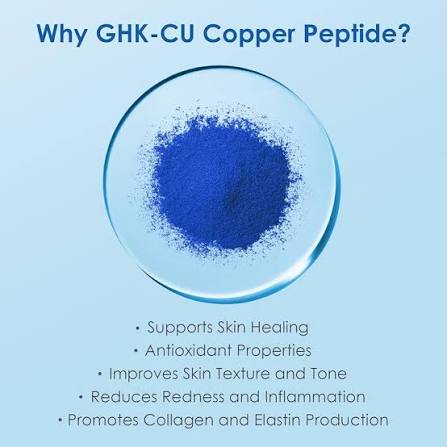
That’s simply the copper. In fact, the blue color is natural and actually indicates the copper ion is present and active. Conversely, a colorless “copper peptide” product may not contain active GHK-Cu at all.